
FireExtinguishers: Types, Classes
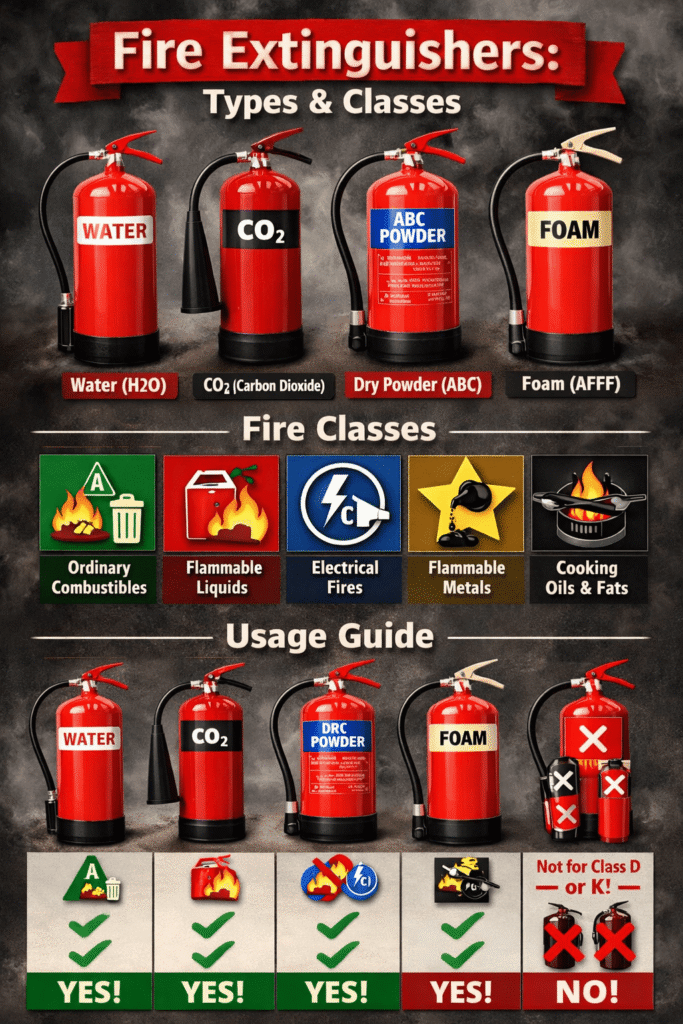
Fire emergencies happen without warning — but having the right extinguisher and knowing
how to use it can prevent serious damage, injury, or loss of life.
Not all fires are the same. Different materials burn in different ways, which is why there are
several types of fire extinguishers designed to combat specific fire classes.
This guide explains:
The five main types of fire extinguishers
Which extinguisher to use for each fire class
Where each type is commonly needed
How to properly use an extinguisher
Why different extinguishers exist
Main Types of Fire Extinguisher
1️⃣ Water (Water Spray or Water Mist) Fire Extinguisher
Water extinguishers are primarily used for Class A fires involving ordinary combustible materials.
Best for:
- Wood
- Paper
- Cloth
- Rubber
- Some plastics
Common Locations:
- Offices
- Schools
- Hospitals
- Residential properties
- Warehouses
⚠️ Never use water on electrical or grease fires.
2️⃣ Foam Fire Extinguisher
Foam extinguishers work by forming a blanket over flammable liquids, cutting off oxygen and preventing re-ignition.
Best for:
- Class A fires
- Class B fires (flammable liquids)
Common Locations:
- Offices
- Retail spaces
- Workshops
- Warehouses
3️⃣ Dry Powder Fire Extinguisher (Standard or Specialist)
Standard Dry Powder (ABC)
Versatile and widely used.
Effective on:
- Class A
- Class B
- Class C (gas fires)
Specialist Dry Powder
Designed specifically for Class D metal fires.
Used in:
- Industrial facilities
- Metal workshops
- Laboratories
⚠️ Powder extinguishers can reduce visibility and cause breathing irritation indoors.
4️⃣ Carbon Dioxide (CO₂) Fire Extinguisher
Carbon dioxide extinguishers leave no residue, making them ideal for sensitive equipment.
Best for:
- Class B fires
- Electrical fires
Common Locations:
- Server rooms
- Laboratories
- Food preparation areas
- Printing/duplicating rooms
Key Advantages:
✔ Leaves no residue
✔ Safe for electronics
Limitations:
- Short discharge range (approximately 3–8 feet / 1–2.4 meters)
- Not ideal outdoors in windy conditions
- Can reduce oxygen levels in confined spaces
5️⃣ Wet Chemical Fire Extinguisher
Designed specifically for high-temperature cooking oils and fats.
Best for:
- Class F (or Class K) fires
- Commercial kitchens
The agent creates a soapy layer that cools and seals the surface of burning oil.
Fire Classes Explained (What’s Burning?)
Understanding fire classes helps you choose the correct extinguisher.
Class A
Ordinary combustibles
Examples: wood, paper, cloth, rubber, plastics
Class B
Flammable liquids
Examples: gasoline, oil, solvents, paints, petroleum greases
Class C
Energized electrical equipment
Class D
Combustible metals
Examples: magnesium, sodium, lithium, titanium
Class F (or K)
Cooking oils and fats (commercial kitchens)
Which Extinguisher Should Be Used for Each Class of Fire?
| Fire Class | Suitable Extinguishers |
| Class A | Water, Water Mist, Foam, Dry Powder, Wet Chemical |
| Class B | Water Mist, Foam, Dry Powder, CO₂, Some Wet Chemical |
| Class C | Water Mist, Dry Powder |
| Class D | Specialist Dry Powder |
| Electrical Fires | CO₂ |
| Class F / K | Water Mist, Wet Chemical |
What Type of Premises Need Water Fire Extinguishers?
Most buildings require either water or foam Fire extinguishers, especially where organic materials are present.
Examples:
- Buildings constructed from wood or organic materials
- Offices
- Schools
- Hospitals
- Residential buildings
- Warehouses
If materials like paper, textiles, furniture, or packaging are present, Class A protection is essential.
How to Use a Fire Extinguisher – The PASS Method
In an emergency, remember PASS:
P – Pull
Pull the pin to unlock the operating lever.
A – Aim
Aim the nozzle at the base of the fire.
S – Squeeze
Squeeze the handle to release the extinguishing agent.
S – Sweep
Sweep from side to side until the fire is completely extinguished.
✔ Always maintain a safe distance.
✔ Ensure the fire is fully out before leaving the area.
Why Do Different Fire Extinguishers Exist?
Fires behave differently depending on what’s burning. Each extinguisher type works in a specific way:
- Cooling the fire (Water extinguishers)
- Smothering and removing oxygen (Foam, CO₂)
- Interrupting the chemical reaction (Dry Powder)
- Creating a barrier between fuel and flames (Wet Chemical)
Using the wrong extinguisher can make a fire worse — especially when water is applied to oil or electrical fires.
Quick Reference: Best Extinguisher by Location
| Location | Recommended Extinguisher |
| Home (General Use) | ABC Dry Chemical |
| Kitchen | Wet Chemical |
| Workshop / Garage | ABC or BC Dry Chemical |
| Laboratory / Server Room | Clean Agent or CO₂ |
| Industrial Metal Shop | Class D |
Take Action for Fire Safety
Preparation saves lives.
- Assess your home or workplace for fire risks
- Install the correct extinguishers in appropriate locations
- Train staff and family members
- Schedule regular inspections and maintenance
Fire safety isn’t optional — it’s essential.